


close
Choose Your Site
Global
Social Media


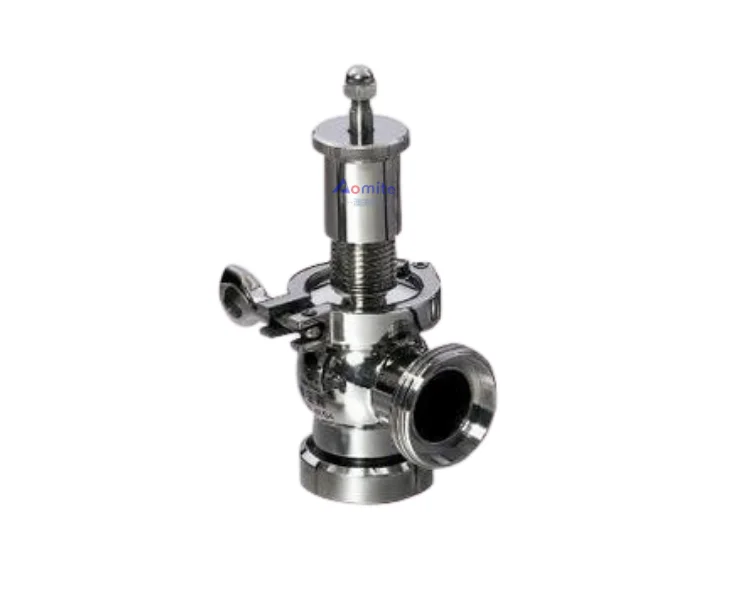
Protect your critical process equipment, pumps, and pipelines from dangerous overpressure surges with the Aomite Sanitary Adjustable Spring-Loaded Safety Relief Valve.
Operating entirely mechanically, this premium hygienic valve acts as a reliable bypass or overflow protector. Under normal operating conditions, the highly tensioned internal spring keeps the stainless steel valve securely closed. If the line pressure exceeds your specific set limit, the valve instantly opens to relieve the flow and reduce pipeline pressure, preventing catastrophic plant damage. Plant operators can easily calibrate the exact relief pressure (standard 0 to 6 bar, with heavier spring options available up to 10 bar) by simply turning the external regulating sleeve and securing it with the locknut. Available in DN25, DN32, and DN50 sizes with either a sandblasted or mirror-polished finish.
| Size: | |
|---|---|
| Quantity: | |


AMTPRVOVERFLOW
AOMITE
AMTPRVOVERFLOW001
| Parameter | Specification |
|---|---|
| Product Type | Sanitary Spring-Loaded Safety Valve / Overflow Bypass Valve |
| Material Grade | AISI 304 or AISI 316L Stainless Steel |
| Available Sizes | DN25, DN32, DN50 |
| Standard Pressure Range | 0 to 6 Bar (Adjustable via regulating sleeve) |
| Max Pressure Option | Up to 10 Bar (Requires heavy-duty spring option) |
| Working Temperature | -20°C to +130°C (-4°F to 266°F) |
| Surface Finish Options | Sandblasting (Matte) or Mirror Polished |
| Key Internal Components | SS304 Spring, Regulating Sleeve, Locknut, Valve Stem, Seat |
| Primary Application | Pump bypass protection, pipeline pressure surge relief in breweries and dairies |
Absolutely Not (100% Spring-Loaded Mechanical)
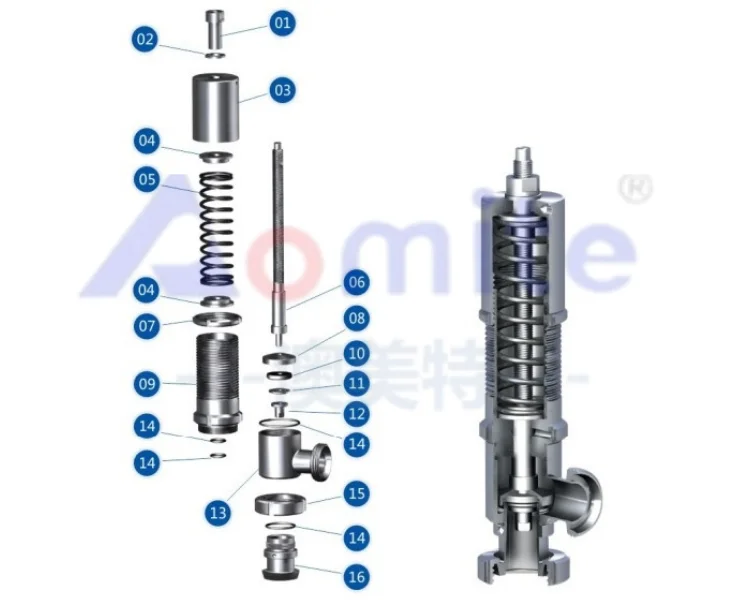
This is a pure spring-loaded safety relief valve. It does not contain a flexible rubber diaphragm to control flow, nor does it use a worm gear (which is a hand-cranked gearbox typically found on massive butterfly valves). The core of this valve is a heavy-duty stainless steel spring. The tension of this spring pushes a metal stem down onto a seal. When fluid pressure pushes up harder than the spring pushes down, the valve opens.
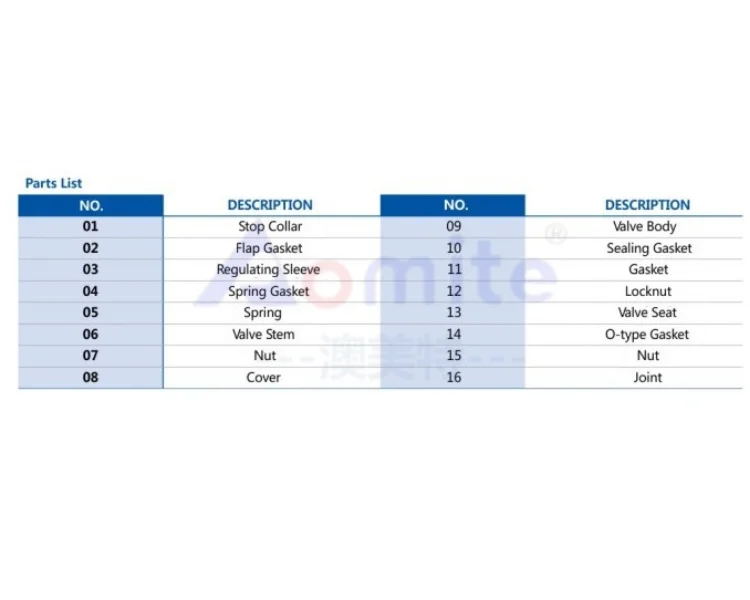
Loosen the Locknut: Locate the locknut (Part #12 in our diagram) just below the main adjusting mechanism. Loosen it to allow the sleeve to turn.
Turn the Regulating Sleeve: Turn the regulating sleeve (Part #03) downwards (clockwise) to compress the internal spring. This increases the tension, raising the pressure threshold (e.g., to 6 bar). Turning it upwards de-compresses the spring, lowering the relief threshold.
Lock the Setting: Once your system gauge confirms the valve opens at the desired pressure, tighten the locknut to secure the setting against pipeline vibrations.
Product Description
2024-04-26 385
Catalogue2022.pdf


